


Origins and history of Carbonara
When it comes to typical Roman dishes, Carbonara is one of the first names that comes to mind.
It is not just a dish, but a little piece of the city’s history, encapsulated in egg, guanciale, pecorino cheese, and pepper.
Its origins are shrouded in curious anecdotes. Some say it was created during World War II, combining simple ingredients that were readily available in American supplies.
Others link it to the charcoal burners of the Sibillini Mountains, who cooked pasta with pork cheek and eggs, ingredients that were easy to preserve and rich in energy.
Walking through the alleys and squares of central Rome, you can still feel the legacy of this history today. Every restaurant has its own interpretation, with slight variations on the original recipe, but the essence remains the same: simplicity, balance, and intense flavor.
Carbonara, therefore, is not just food: it is memory, it is atmosphere, it is the rhythm of the city that enters the dish.
Essential ingredients and characteristics
The strength of one of Rome’s most typical first courses lies in the choice of ingredients.
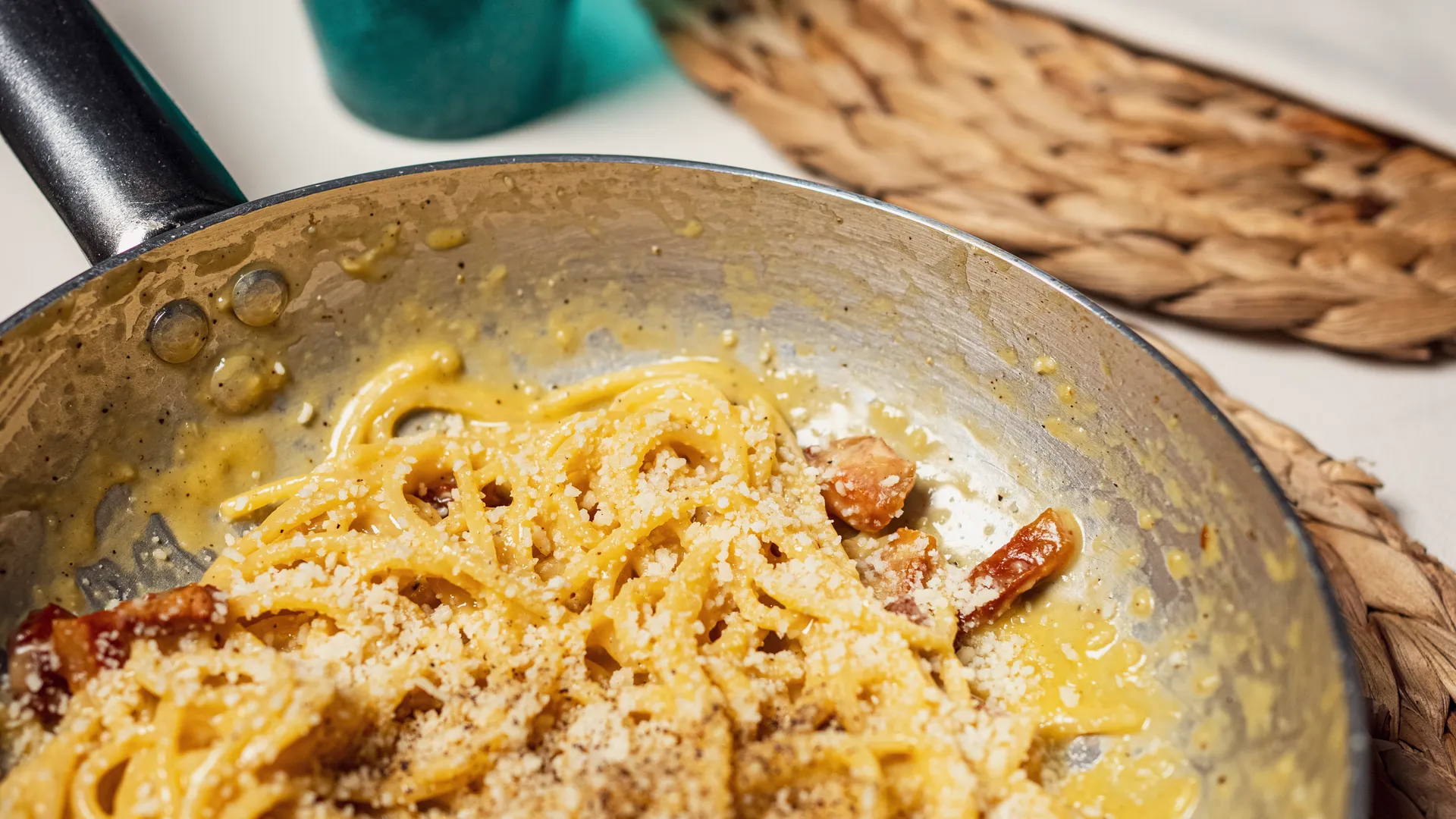
- The pasta, strictly spaghetti or rigatoni, must be cooked al dente and ready to be tossed with the egg and pecorino cream sauce.
- The guanciale, cut into strips, is browned until crispy, releasing intense aromas that fill the kitchen.
- Freshly ground black pepper completes the dish with its pungent, almost musical note, which blends with the creaminess of the sauce.
There are no complicated sauces, no added cream or onion—the secret lies entirely in the technique, in understanding when the egg meets the pasta and transforms into a velvety cream without overcooking.
Every bite reveals a contrast: the crunchiness of the guanciale against the softness of the pasta, the strong flavor of the pecorino cheese against the natural sweetness of the egg.
If you close your eyes, you can almost feel Rome around you: the sound of footsteps on the cobblestones, the smell of nearby markets and historic restaurants.
Carbonara in Rome thus becomes a sensory experience, not just a gastronomic one.
Here, Roman cuisine demonstrates its ability to transform a few ingredients into something memorable.
Carbonara: why it is loved
If you ask a Roman what typical Roman dish is not to be missed, Carbonara immediately tops the list. The reason is simple: it is substantial, immediate, satisfies the palate, and tells a story without needing any explanation.
Eating it in the center of Rome means immersing yourself in narrow alleys, lively squares, and historic views, with the aroma of guanciale whetting your appetite for that first bite.
Each restaurant adds its own twist: a touch of more intense pepper, slightly wider pasta, or a creamier sauce. But the essence remains unchanged.
It is loved because it conveys simplicity, tradition, and memory. No artifice is needed: the dish speaks for itself.
Sitting down at a table at Virginea means enjoying Carbonara as a complete experience. It’s not just the taste, but also the sight of the steaming pasta, the noise of the restaurant, the warm lighting, and the carefully arranged tables.
Every detail contributes to a sensory experience that makes this classic Roman first course even more memorable.
And then there is the connection with the city: Carbonara is the symbol of a tradition that is renewed every day, in restaurants, in dishes served in the center of Rome, among squares, alleys, and small glimpses that can be discovered while walking.
It is loved because it is concrete, sincere, capable of conveying simple but profound emotions to those who experience it.
Carbonara in Rome: a few final observations
Carbonara in Rome is the perfect example of how typical Roman dishes combine taste and history.
It needs no artifice: every bite is a step into tradition, every aroma is a little memory of the city. The simplicity of the dish and the richness of its sensory details make it one of the most authentic symbols of Roman cuisine.
Sitting down at Virginea’s table, savoring the egg cream that coats the spaghetti and feeling the crunch of the guanciale, means coming into contact with the real Rome, the one that can be enjoyed with your eyes, nose, and mouth.